
Sign up for the Today newsletter
Get everything you need to know to start your day, delivered right to your inbox every morning.
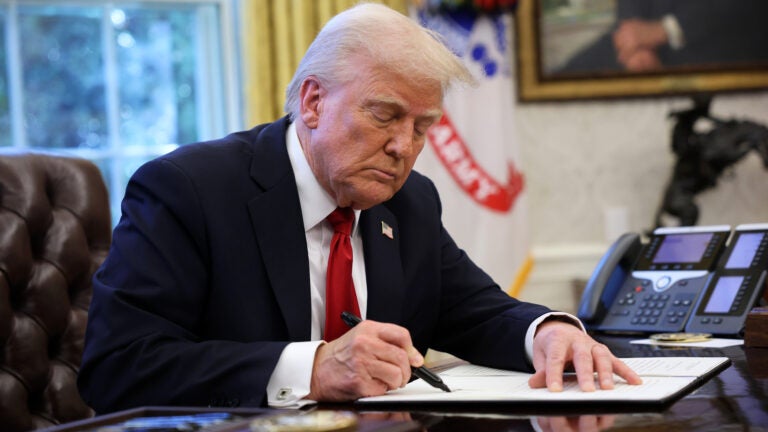
Officials and experts expressed concerns this week after President Donald Trump signed an executive order on Tuesday which seeks to extensively overhaul US elections.
The executive order includes requiring documentary proof of citizenship to register to vote in federal elections and taking action to prosecute election crimes. It also demands that states reject any ballots not received by Election Day, a move that seems to target mail-in heavy states.
“It’s quite nonsensical, the whole thing,” said Secretary of the Commonwealth of Massachusetts William F. Galvin. “Even if you agreed with it, what they put out there is not a cohesive proposal.”
The order threatens to pull federal funding from any states whose election officials do not comply with its actions.
“I call it a messaging [executive order] because there’s so much in the executive order that will get political pushback or defeat in the courts that I doubt much of any of it actually will be enacted, certainly at the federal level in this administration,” said Charles Stewart III, the founding director of the MIT Election Data and Science Lab.
What the executive order essentially boils down to is “an attempt by the federal government to dictate to the states how they run elections,” Stewart said.
“It’s not a legislative thing, it’s not something that’s been debated, it’s not something that’s been discussed,” Galvin said. “It’s ideas that he throws out. It’s dangerous, and it diminishes the rights of citizens.”
Ruth Greenwood, the director of the Election Law Clinic at Harvard Law School, says that the executive order is “pretty clearly unconstitutional.”
In particular, the new citizenship requirements could significantly limit the options available to voters who are currently able to cast their votes in federal elections with ease. The actions proposed in the executive order reach even farther than bills such as the Safeguard American Voter Eligibility (SAVE) Act already do.
“A lot of groups have criticized the SAVE Act, which is in Congress at the moment, but it at least has an affidavit alternative where you can swear to the fact that you’re a citizen,” Greenwood said. “This one doesn’t have any of that alternative; if you don’t have the documents, you are out of luck.”
Among the voters who are most likely to be affected by the documentary proof of citizenship requirements are rural voters, women who take another name after marriage, and people of color, Greenwood said.
“All of this stuff that he says are crimes, they’re already crimes, and they’re already things that would be prosecuted,” Greenwood said. “So, to the extent that this very tiny amount of fraud exists, it’s already caught by the current system.”
One pre-existing example that other states can turn to is Arizona’s citizenship requirements. Though the overall impact isn’t as large, a significant group of voters are still affected, according to Stewart.
“What they’ve discovered is that, first of all, there’s a small but not trivial number of people who are unable to vote because they haven’t provided documentary proof of citizenship,” Stewart said. “And the second thing is, overwhelmingly, these are students, and so it’s basically young people, but particularly students, who are then unable to vote in, in this case, state elections.”
As for how the executive order could impact Massachusetts voters if passed, Greenwood says the biggest hurdles will be the proof of citizenship requirements and the Election Day deadline for ballots.
“We’ve only just got excused absentee voting in Massachusetts, and it’s been widely utilized since 2020, and it would be a shame to go backwards and make it harder for election administrators,” Greenwood said.
Whether or not the executive order will stick is currently unknown and will likely depend on what legal challenges are brought before it. Until then, Greenwood said, Massachusetts voters should continue to rely on the same sources as before to ensure that they know their rights.
“I would rely on people like the League of Women Voters, the ACLU of Massachusetts … to be able to provide accurate information,” Greenwood said. “For now, the law is exactly as it was before the executive order, and people should just continue to trust in the sources that they’ve trusted until now.”
Get everything you need to know to start your day, delivered right to your inbox every morning.



To comment, please create a screen name in your profile
To comment, please verify your email address
Conversation
This discussion has ended. Please join elsewhere on Boston.com