
Sign up for the Today newsletter
Get everything you need to know to start your day, delivered right to your inbox every morning.
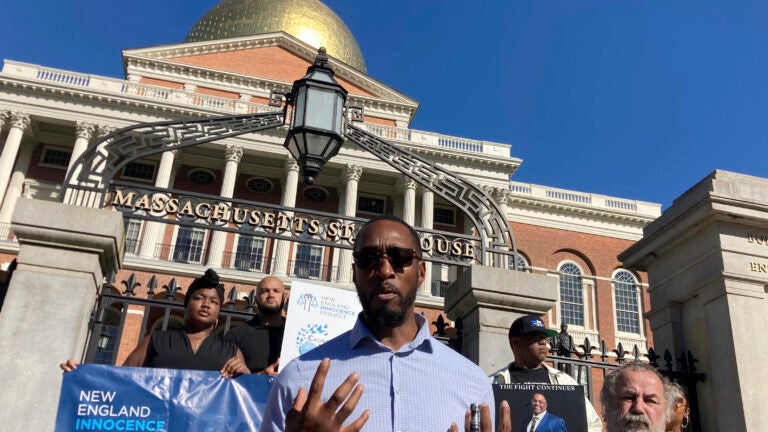
A Massachusetts man imprisoned for 26 years for murder was proven innocent and awarded $13 million by a jury last week. But, state law cuts that award down to a maximum of $1 million.
Michael Sullivan, of Lowell, was convicted in 1987 of the murder of Wilfred McGrath, who was found dead wrapped in a quilt behind an abandoned Stop & Shop in Somerville the year before, according to court documents.
A jury found that he proved “by clear and convincing evidence” that he was innocent of murder, armed robbery, and all other related charges. The jury ruled that he should be paid $4 million for his loss of freedom and $9 million for his pain, suffering, and emotional distress.
A state law caps the damages paid by the state in wrongful conviction suits at $1 million.
Sullivan’s lawyer told The Boston Globe it’s more important that he was completely exonerated of the crime.
“The million dollars can make a big difference in his life. He’s thrilled with it. Would he have liked it to be 13? Sure. But he has no hard feelings at all about that,” Michael Heineman told the Globe. “His main concern was getting that declaration, because he still hears people whispering, ah, he got off on a technicality.”
Sullivan was 26 when he was convicted of murder and armed robbery in 1987. He remained in prison until 2013. The criminal case against him was dropped in 2019.
Gary Grace, who Sullivan and his lawyers assert actually committed the crime, gave police false testimony in exchange for a deal, while a Massachusetts State Police chemical analyst falsely attributed physical evidence to Sullivan, his lawyers said.
According to a complaint filed in Suffolk Superior Court, there was compelling evidence against Grace, including “overwhelming forensic evidence” that established his apartment as the murder scene. Grace pleaded guilty to lesser charges and testified that Sullivan beat McGrath.
While another person involved testified that Sullivan wasn’t involved, another piece of physical evidence placed him at the crime scene. Robert Pino, the chemical analyst, asserted that there was blood and hair found on Sullivan’s jacket, which implicated him, the complaint said.
Pino was fired in 2007 from the MSP crime lab after working as a chemist for more than two decades, the complaint said. He “had allowed the collection of samples not reported by law, reported incomplete results to police, and failed to report DNA database matches to prosecutors until after the statute of limitations for the crimes had elapsed,” according to the complaint.
Sullivan’s motion to retest his clothing was granted in 2011. His jacket tested negative for blood, and McGrath’s DNA wasn’t found. The test comparing the hair to McGrath’s was “inconclusive,” the complaint said.
“Pino simply fabricated evidence,” the complaint said, “evidence which proved to be the difference between guilt and innocence.”

Get everything you need to know to start your day, delivered right to your inbox every morning.




To comment, please create a screen name in your profile
To comment, please verify your email address
Conversation
This discussion has ended. Please join elsewhere on Boston.com